How to Prepare for a Building Assessment Certificate Across Multiple Higher-Risk Buildings
A Building Assessment Certificate application is not simply a request to upload a set of documents. It is an assessment of whether the Accountable Persons for a higher-risk building are meeting their ongoing legal duties to identify and manage building safety risks.
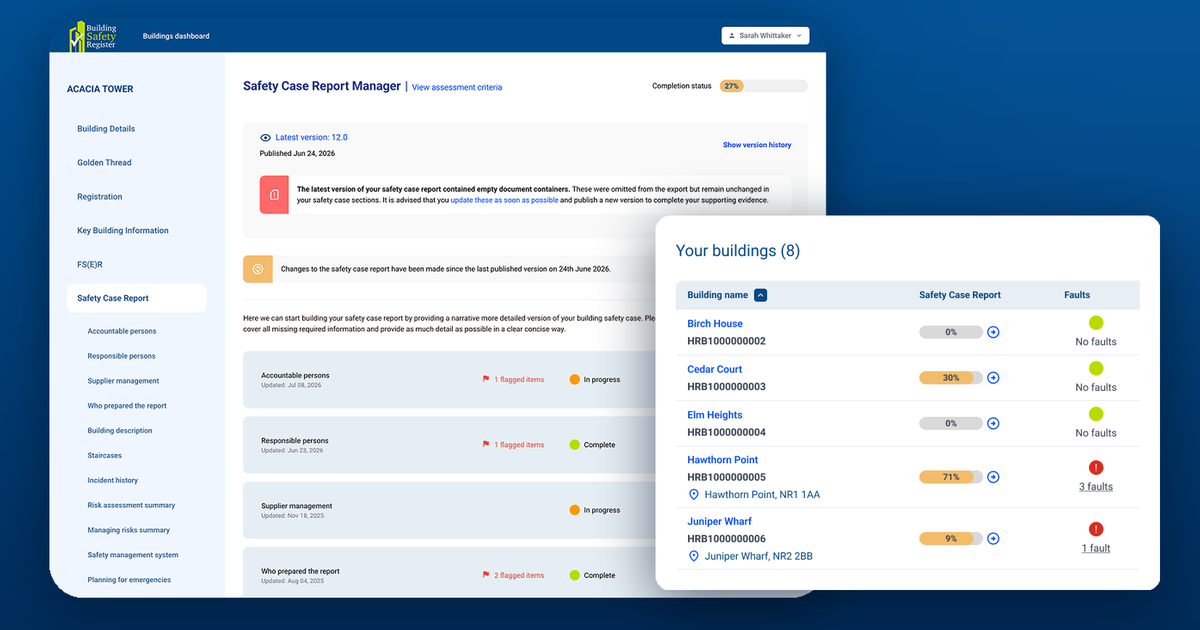
For Principal Accountable Persons responsible for multiple higher-risk buildings, the practical challenge is therefore much wider than completing an application within the required timeframe. Each building needs an up-to-date Safety Case Report, supporting evidence, clear ownership of actions and reliable processes that can be demonstrated when the regulator asks.
This guide explains the current Building Assessment Certificate process, the Building Safety Regulator’s announced change in approach and what organisations can do now to improve readiness across their portfolios.
Important: This article reflects official information available on 16 November 2026. The regulator has announced that its approach to Building Assessment Certificates will change, but the legal duties of Principal Accountable Persons and Accountable Persons remain in force. Always check the latest official guidance before submitting an application.
What is a Building Assessment Certificate?
A Building Assessment Certificate, often shortened to BAC, is issued by the Building Safety Regulator when it is satisfied that the relevant duties for an occupied higher-risk building are being complied with.
The assessment considers duties relating to:
- Assessing building safety risks.
- Managing building safety risks.
- Preparing and maintaining the Safety Case Report.
- Operating a mandatory occurrence reporting system.
- Providing prescribed building safety information.
- Producing and implementing a resident engagement strategy.
The Building Safety Act 2022 requires the regulator to issue a certificate if it is satisfied that the relevant duties are being met. If it is not satisfied, it must refuse the application, subject to provisions that may allow a contravention to be remedied promptly.
Official guidance describes a certificate as a “snapshot” of compliance at the time of assessment. It is not a guarantee of continuing compliance or safety. The responsibilities of PAPs and APs continue after a certificate has been issued.
Who needs to apply for a Building Assessment Certificate?
The Principal Accountable Person for an occupied higher-risk residential building must apply when directed to do so by the Building Safety Regulator.
A PAP cannot choose to begin the formal application process independently. The regulator will contact the PAP using the details held for the building and provide instructions on when to apply.
Under the current published process, the PAP has 28 calendar days from the regulator’s direction to submit the application. This is why readiness cannot sensibly begin when the call-up arrives.
The official Building Assessment Certificate application guidance explains how to apply once directed.
Has the Building Safety Regulator changed its approach?

In July 2026, the Building Safety Regulator and the Ministry of Housing, Communities and Local Government announced plans for a more proportionate, targeted and intelligence-led approach to Building Assessment Certificates.
The announcement said the regulator would concentrate on existing applications while future processes were finalised. The planned approach included:
- Initially concentrating on organisations responsible for multiple higher-risk buildings.
- Using sample interventions informed by risk or intelligence about buildings, organisations or duty holders.
- Giving smaller, volunteer-led resident management organisations more time to prepare evidence.
- Providing further support for applications already in progress and for buildings previously refused a certificate.
- Developing clearer assessment criteria and technical guidance.
These are important changes in regulatory approach, but they do not remove or suspend the underlying legal duties. The regulator explicitly stated that PAPs must not wait for a future assessment before preparing their Safety Case Reports.
Read the full official announcement about the regulator’s targeted approach.
Organisations should distinguish between what has been announced and what has been formally implemented. Until revised arrangements and guidance are confirmed, PAPs should continue to follow the current official application guidance and maintain evidence of ongoing compliance.
Why organisations managing multiple HRBs should take notice
The regulator’s announcement placed particular emphasis on organisations responsible for multiple higher-risk buildings, including local authorities, housing associations and larger landlords. It also proposed a single point of contact for PAPs responsible for multiple HRBs.
The risk-led approach means regulatory attention may extend beyond an individual building. Sample interventions could be informed by intelligence or risk relating to a building, an organisation or a duty holder. Where the same PAP is responsible for several HRBs, readiness should therefore be considered across the PAP’s portfolio, not only for the next building expected to receive a BAC call-up.
For readiness planning, this points to the need for portfolio-wide assurance: consistent safety-management arrangements, reliable evidence for each building and clear oversight of risks, controls and actions. Each HRB still requires its own building-specific assessment and evidence, but the organisation should be able to demonstrate that its wider governance and management processes operate consistently in practice.
This creates a portfolio-level challenge. A process that appears manageable for one building can become difficult to control when repeated across tens or hundreds of properties, different teams and several managing agents or specialist consultants.
Typical problems include:
- Different document structures or naming conventions for each building.
- Evidence held across shared drives, email inboxes and supplier systems.
- Unclear ownership of safety actions.
- Inconsistent processes for reviewing risks and control measures.
- Expired assessments or documents with no reliable review alert.
- Difficulty establishing which version is current.
- Limited senior-level visibility across the whole portfolio.
- Safety Case Reports being treated as finished documents rather than live records.
These issues do not necessarily mean that safety work has not taken place. They do, however, make it harder to demonstrate consistently what has been done, why decisions were made, who is responsible and whether actions have been completed.
What will the regulator assess?
The regulator is assessing compliance with legal duties, not presentation alone. The application includes three particularly important areas of evidence:
- The Safety Case Report.
- The resident engagement strategy.
- Information about the mandatory occurrence reporting system.
The PAP must also confirm that required information is being provided to relevant people and organisations and provide details of any Building Safety Regulator compliance notices currently in force.
During its assessment, the regulator may ask for additional records or documents. It may arrange a meeting to discuss the application or the management of building safety risks. Official guidance also says it may ask the PAP to demonstrate systems used to manage those risks, such as the maintenance of control measures.
That distinction matters. A Safety Case Report can describe a good process, but the underlying records need to show that the process operates in practice.
The regulator’s guidance on preparing a Building Assessment Certificate application should be treated as the primary reference when preparing for the formal process.
Building Assessment Certificate readiness checklist
The following checklist is not a substitute for official guidance or professional advice. It provides a practical starting point for reviewing whether your information and processes are likely to be ready for scrutiny.

Core regulatory information
Establish that the building record, Safety Case and supporting evidence are current and defensible.
01
Confirm that registration information is current
Check that the regulator holds the correct PAP and building contact details. Review the registered building information and ensure changes are dealt with through the appropriate official process.
02
Review the Safety Case Report
Confirm that the report reflects the building as it exists now, not its position when the first draft was produced.
It should clearly explain:
- The building and its particular characteristics.
- The fire spread and structural failure scenarios identified.
- How risks have been assessed.
- The preventative and mitigating measures in place.
- How those measures are maintained and monitored.
- Who is responsible for managing risks and completing actions.
- How performance, change and continuous improvement are managed.
Our guide to preparing a Safety Case Report for the Building Safety Regulator examines this in more detail.
03
Test the connection between statements and evidence
For each important claim in the Safety Case Report, ask:
- What evidence supports this statement?
- Is that evidence current?
- Can the correct version be found quickly?
- Does it relate to the correct building, system and period?
- Is there a clear record of review or approval?
A report that cannot be traced back to reliable supporting information will be harder to defend.

Managing risks and actions
Demonstrate that identified issues are owned, monitored, completed and evidenced in practice.
04
Review open actions and recommendations
Identify actions arising from risk assessments, inspections, maintenance, incidents, audits and specialist reports.
Each action should have:
- A clear description.
- An accountable owner.
- A realistic due date.
- A recorded priority or risk basis where appropriate.
- Evidence of completion.
- A process for escalation if it becomes overdue.
Closing an action should mean more than changing its status. The completion record should show what was done and retain the evidence needed to support that decision.
05
Confirm that control measures are actively managed
Review how preventative and mitigating measures are inspected, tested, maintained and monitored. Check that any failure or deterioration can be identified, assigned and followed through.
This is particularly important because the regulator may ask for a demonstration of the systems used to manage safety risks, rather than relying solely on the written description of those systems.
06
Check the resident engagement strategy
Confirm that the strategy is current and has been implemented in practice. Retain evidence of communications, participation, complaints and the organisation’s response to relevant resident concerns.
07
Check the mandatory occurrence reporting system
Ensure the system is established, understood by relevant people and supported by clear records. Staff and contractors should know how potential occurrences are identified, escalated and reported.

Testing portfolio readiness
Test whether information can be retrieved consistently and whether senior teams can see where attention is needed.
08
Review information-sharing arrangements
Check what information must be supplied to residents, other Accountable Persons, the regulator and other relevant organisations. Confirm that sharing is controlled, current and recorded.
09
Run a retrieval test
Choose a material risk, control measure or recently completed action and ask the responsible team to produce the relevant information and history.
Can they quickly show:
- The latest approved document.
- Earlier versions where relevant.
- The responsible person.
- Associated actions and decisions.
- Evidence that required work was completed.
- When information was reviewed or shared.
A retrieval test can reveal gaps that remain hidden during a high-level document review.
10
Compare readiness across the portfolio
Apply the same review consistently to every HRB. A dashboard or summary should not obscure building-specific gaps, but senior teams need a reliable way to identify which buildings, risks or actions require attention first.
Why a collection of documents is not enough
The BAC process is sometimes approached as an exercise in assembling three key documents. Those documents are essential, but they sit above a much larger body of operational evidence.
The Safety Case Report should explain how building safety risks are managed. The Golden Thread should provide the accurate, accessible and current information that supports that explanation. Action-management records should demonstrate what happens when a gap or improvement is identified.
If these elements are disconnected, teams can spend significant time reconciling reports, spreadsheets, shared folders and email trails. More importantly, it becomes harder to maintain a clear and current view of risk.
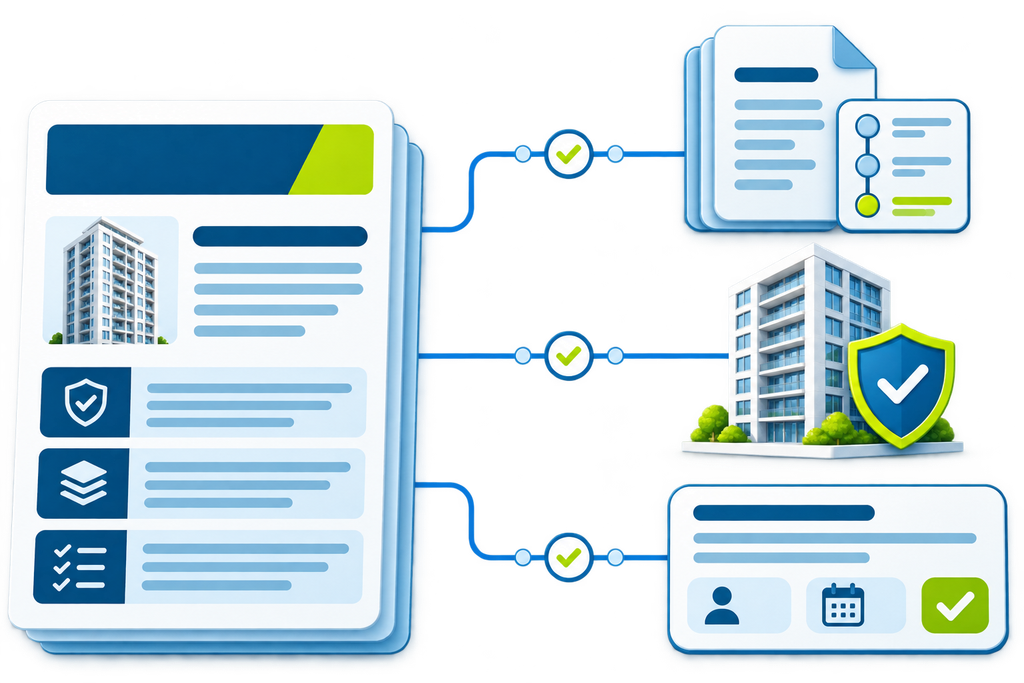
A structured digital approach can support:
- Consistent information structures across buildings.
- Clear ownership and monitoring of actions.
- Version and review-date control.
- Traceable links between risks, controls, statements and evidence.
- Permission-controlled access for internal and external contributors.
- An audit history showing how information has changed.
- Portfolio oversight without losing building-level detail.
The objective is not digitisation for its own sake. It is to make the organisation’s safety-management arrangements easier to operate, review and demonstrate.
What should PAPs do before receiving a call-up?
Do not try to predict the precise date on which each building will be assessed. Use the time available to improve the underlying management system.
Start by identifying the building with the greatest combination of risk, missing evidence and incomplete actions. Test the readiness process there, correct weaknesses and then apply a consistent method across the portfolio.
Priorities should include:
- Bringing Safety Case Reports up to date.
- Establishing a controlled source for Golden Thread information.
- Linking Safety Case statements to supporting evidence.
- Reviewing overdue or poorly defined actions.
- Confirming that accountable owners understand their responsibilities.
- Testing whether information can be retrieved and explained under scrutiny.
- Recording changes as risks, buildings and control measures evolve.
This approach improves more than BAC readiness. It supports the ongoing management of building safety risks that the assessment is intended to examine.
Frequently Asked Questions
No. The Principal Accountable Person must apply when directed by the Building Safety Regulator. The PAP cannot self-nominate a building for the formal application process.
Under the current published process, the PAP has 28 calendar days after the regulator directs them to apply. Organisations should prepare and maintain the required information before receiving that direction.
The application requires the Safety Case Report, the resident engagement strategy and information about the mandatory occurrence reporting system. The PAP must also provide or confirm other prescribed information, and the regulator may request additional evidence during its assessment.
No. Official regulator information describes it as a snapshot at the time of assessment. PAPs and APs remain responsible for their ongoing legal duties and for continuing to manage building safety risks.
No. The regulator’s July 2026 announcement said that legal duties remain in place and PAPs must not wait for future assessments before preparing Safety Case Reports. Further changes to the assessment process should be checked against the latest official guidance.
Connect your Safety Case to the evidence behind it
See how the Building Safety Register helps you structure your report, maintain supporting Golden Thread evidence and manage actions across your HRB portfolio.
Subscribe To Building Safety Updates
If you would like to keep up to date with Building Safety related news and research like this, please sign up to our mailing list here:
Subscribe to Our Mailing List