
Building Safety in 2025: A Year in Review and What to Expect in 2026
This year-end review explores the state of building safety in 2025, drawing on insights from data, regulation, resident experience and digital transformation. Returning contributors share what changed, what hasn’t, and what 2026 may demand from industry and regulators.
Overview
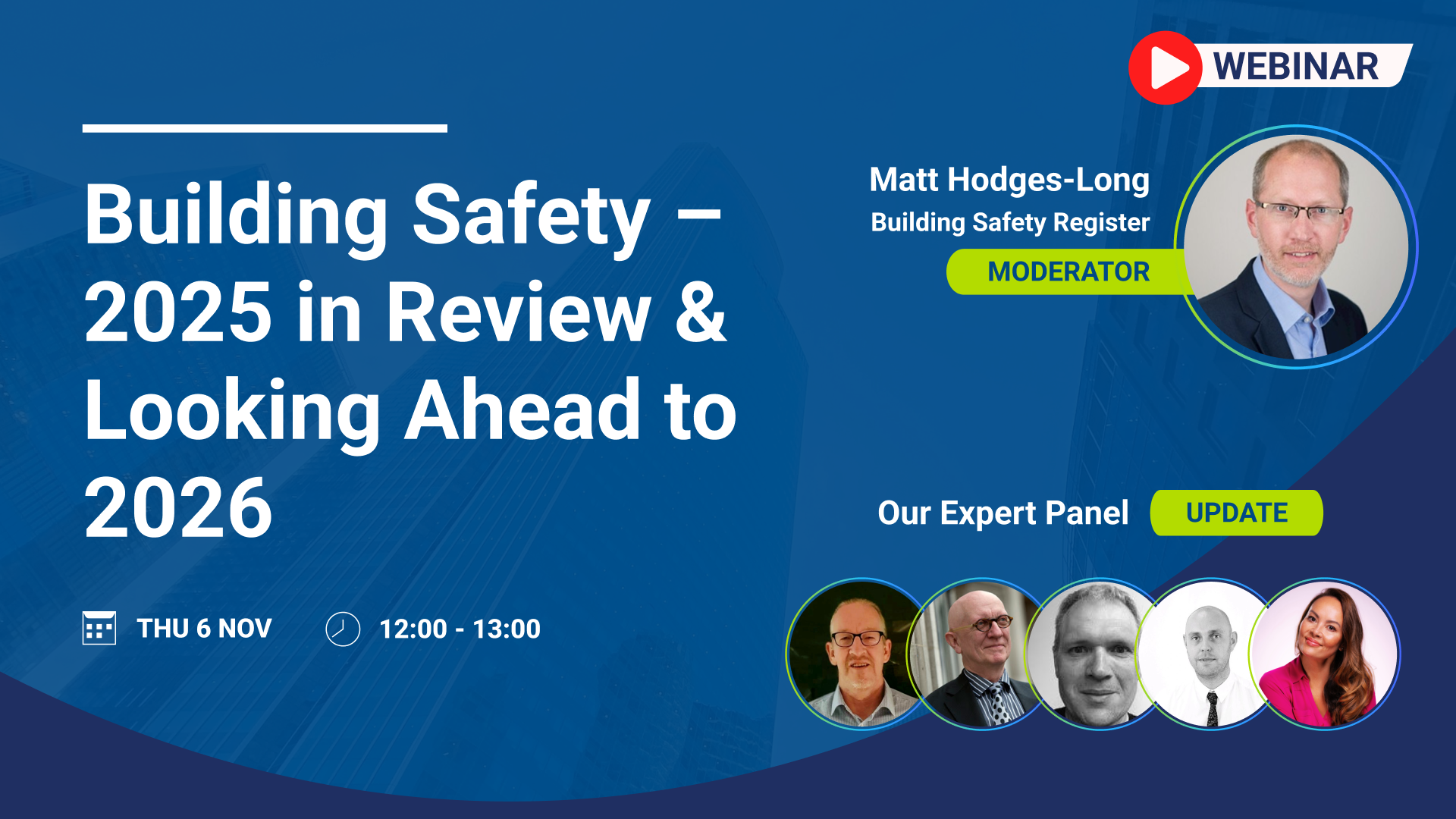
The final Lunch and Learn of the year, hosted by Matt Hodges-Long, brought together a panel of returning contributors to reflect on the state of building safety in 2025 and what may lie ahead in 2026.
The session brought insights from across the sector, including:
- Steve Bunce – Building Safety Case Manager, Lewisham Council
- James Capper – Technical Director, Wildheart Residential
- Simon Lay – Fire Engineer and PhD Researcher (Data and Regulation)
- Melisa White – Founder of KindStay (Resident Support and Prohibitions)
Together, they explored what has improved, what continues to challenge the sector, and how both data and lived experience are shaping the future of building safety.
Discussions focused on:
- the maturity (and limitations) of the HRB Public Register,
- slow and costly regulatory processes,
- resident experience during prohibitions,
- and early signs of digital transformation through supervisory technology (SupTech).
The panel shared observations from local authority enforcement, Principal Accountable Persons, data analysis, fire engineering, and resident impact. The session also explored how 2026 may shift priorities toward outcomes, reform, and technology-enabled regulation.
Here are the key takeaways from the session:
Details
1. Progress is happening — but unevenly across the system
Across the year, key improvements were observed in industry understanding of Gateway requirements, higher-risk building registration, and Safety Case preparation. However, contributors noted that progress varies widely depending on:
- competency within building ownership/management teams
- availability of digital records or golden thread information
- the regulatory capacity of local authorities and the BSR
Steve Bunce highlighted how local authorities are gaining a clearer picture of building risk, but workload, process constraints and building complexity continue to slow enforcement..
2. The HRB Public Register is growing, but still not reliable
Analysis shared by Matt Hodges-Long and based on work with Simon Lay showed that although the HRB Public Register now represents over 13,000 unique buildings and around one million homes, the dataset still contains:
- inconsistent building naming
- duplicated records
- incorrect postcode fields
- no search by PAP, building name, or BAC status
While the register improves visibility for residents and the sector, data quality continues to limit what can be confidently interpreted from it.
3. Regulatory processes remain slow and costly
Following observations earlier in the year, contributors noted that requests for information (RFIs) and document handling continue to repeat work, delay assessments and inflate costs.
Repeated submissions via email links, SharePoint folders and zipped file transfers undermine:
- audit integrity
- tracking of evidence
- the golden thread principle
- efficient decision-making
James Capper emphasised the impact on Principal Accountable Persons, who face cost uncertainty and unclear response timelines.
4. Residents remain the “unmeasured data point” in building safety
Melisa White reiterated that thousands of residents across the UK have been displaced due to prohibitions related to fire and structural safety. Yet there remains:
- no national reporting on resident outcomes
- no mandated standards for relocation or like-for-like accommodation
- inconsistent communication and well-being support
Data may chart building compliance, but it does not yet measure human impact.
5. Misunderstanding of problem scale and regulatory focus
Simon Lay observed that the data indicates a fundamental misunderstanding of the scale and complexity of the problem when the regulatory regime was established, arguing that dealing with residential buildings is uniquely difficult because the residents themselves create and are part of the hazard management. He further commented:
- focus is on new builds rather than the legacy estate, where the hazard truly lies
- still too much emphasis on complex external elements instead of simpler issues like fire doors and smoke control systems
- better use of data and triaging of buildings, rather than processing applications on a first-come, first-served basis
- understanding the permanence of works like scaffolding, as seen in the Spectrum building
The sector needs data-driven triage and regulatory recognition.
Summary
This webinar brought together practitioners who worked at the frontline of building safety in 2025. Their reflections show progress in understanding and implementing the Building Safety Act, but also reveal a system restricted by data inconsistencies, slow processes, and limited measurement of resident experience.
The emerging message for 2026 is clear: a functioning regime must be digital, risk-led, and human-centred.
The Lunch and Learn series will return in 2026, continuing to explore how the sector can progress toward a more transparent, efficient and resident-focused building safety system.
The next session will take place on Thursday 5th February 2026 at 12:00 PM.
Watch the video replay of our Building Safety in 2025 Year in Review webinar
Watch video replayDownload the Building Safety in 2025 Year in Review webinar slides
Free downloadResponsible for a Higher-Risk Residential Building?
Are you responsible for a Higher-Risk Building and need to review your compliance position under the Building Safety Act?
Our team provides structured support to help you get regulator ready.
Speak to Our Team