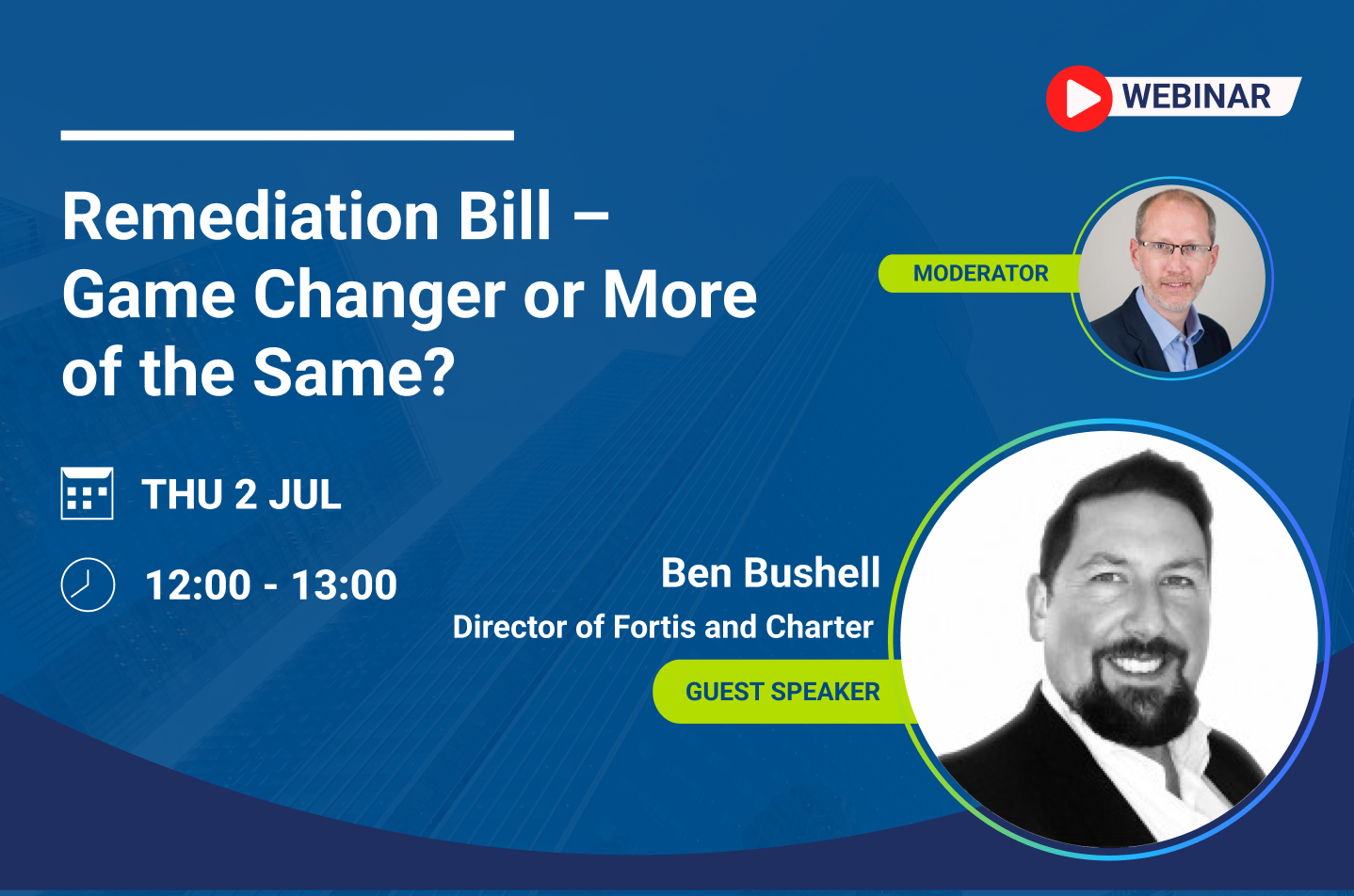
Remediation Bill – Game Changer or More of the Same?
This Lunch & Learn explored one of the most significant pieces of proposed legislation currently facing the building safety sector: The Remediation Bill.
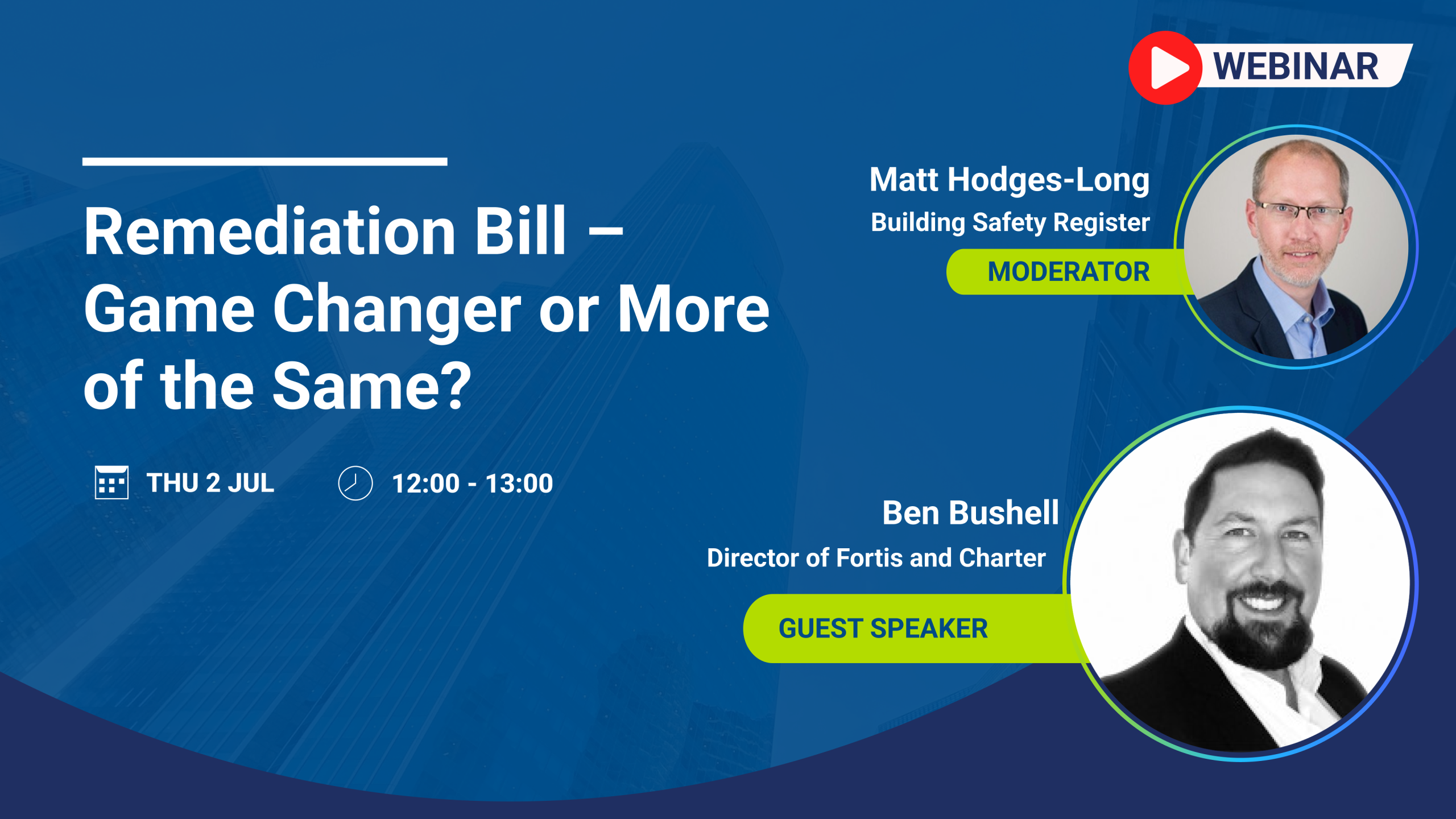
Joining Matt Hodges-Long was Ben Bushell C.Build E MCABE, MICWCI, Director at Fortis & Charter Ltd, who shared his practical experience of supervising complex remediation projects and examined whether the proposed legislation has the potential to transform the industry, or whether the challenges lie far deeper than legislation alone.
Overview
The discussion highlighted that while the proposed Remediation Bill sets ambitious targets for accelerating remediation, delivering meaningful progress will depend on far more than legislation alone.
- Ambitious remediation deadlines: The proposed completion dates of 2029 for buildings over 18m and 2031 for buildings between 11m and 18m represent a significant challenge given the current pace of remediation.
- Data and identification: Questions remain over how affected buildings will be identified and whether a national remediation database can become a genuine single source of truth.
- Hidden construction defects: Real remediation projects continue to uncover significant structural issues that cannot always be identified during intrusive surveys, resulting in additional design work, programme delays and increased costs.
- Quality assurance: Effective site supervision and independent inspection remain critical to ensuring remediation works are completed safely and in accordance with regulatory requirements.
Details
What the Remediation Bill Proposes
Matt Hodges-Long outlined the Government’s three stated objectives for the proposed legislation:
- Accelerate the pace of remediation.
- Improve identification of buildings requiring remediation.
- Provide greater support for affected residents.
The proposed legislation would introduce completion targets of December 2029 for buildings over 18 metres and December 2031 for buildings between 11 and 18 metres. It also proposes new duties around building assessments and may formalise the use of PAS 9980 as part of the remediation process.
Can the Proposed Deadlines Be Achieved?
One of the central themes of the discussion was whether the proposed deadlines are realistically achievable.
Drawing on Government remediation statistics, Matt highlighted that while significant progress has been made, thousands of residential buildings still require remediation or have yet to begin work. Questions were also raised over the completeness of existing datasets, particularly as many lower-rise buildings remain outside current reporting.
Ben Bushell explained that remediation programmes are rarely straightforward. Funding arrangements, planning requirements, Gateway 2 approvals, procurement and evolving project scopes all contribute to lengthy delivery programmes, making fixed national deadlines difficult to achieve in practice.
The Reality of Remediation Projects
One of the most valuable parts of the session came from Ben’s real-world examples of remediation projects.
Using recent case studies, he demonstrated how intrusive surveys can only reveal so much before construction begins. Once external wall systems are removed, previously hidden defects often emerge, fundamentally changing the scope of the project.
Examples included:
- Structural timber elements that failed to meet current standards.
- Incorrect fixing methods that created life safety concerns.
- Balcony drainage defects resulting in standing water and extensive steel corrosion.
- Hidden service penetrations requiring additional fire stopping and structural works.
These unforeseen issues frequently require additional engineering input, design revisions and contract variations, extending programmes by months or, in some cases, years.
Why Professional Oversight Matters
Ben emphasised the importance of experienced project oversight throughout remediation works.
As projects evolve, decisions often need to be made quickly while maintaining compliance with changing designs and regulatory requirements. Independent inspection through a Clerk of Works helps ensure workmanship is maintained, unexpected defects are properly addressed and buildings remain compliant throughout construction.
Without appropriate oversight, there is a significant risk that hidden defects remain unresolved or that remediation work fails to achieve the intended long-term safety outcomes.
Political and Industry Uncertainty
The discussion also considered the wider political context surrounding the proposed legislation.
Matt highlighted that, while the Remediation Bill has been announced, questions remain regarding its parliamentary timetable and the level of detail currently available. Attendees were encouraged to recognise that further changes may emerge as the Bill progresses through Parliament.
Regardless of how the legislation develops, both speakers agreed that collaboration across Government, regulators and industry will remain essential if remediation programmes are to accelerate successfully.
Summary
The proposed Remediation Bill represents another important milestone in the evolution of building safety legislation.
However, as this session demonstrated, successful remediation depends not only on legislative ambition, but also on realistic programmes, robust funding, high-quality project delivery and experienced technical oversight.
While the proposed deadlines provide clear direction, the practical realities of remediation projects continue to present significant challenges that will require collaboration across the entire sector.
Next Steps & Resources
- Next Lunch & Learn: Join us at our next webinar on 3rd September 2026 as we continue to explore the latest developments in post Grenfell building safety.ere encouraged to start submitting questions regarding building safety and housing policy.
Watch the video replay of our Remediation Bill – Game Changer or More of the Same? webinar
Watch video replayDownload the Remediation Bill – Game Changer or More of the Same? webinar slides
Free downloadResponsible for a Higher-Risk Residential Building?
Are you responsible for a Higher-Risk Building and need to review your compliance position under the Building Safety Act?
Our team provides structured support to help you get regulator ready.
Speak to Our Team